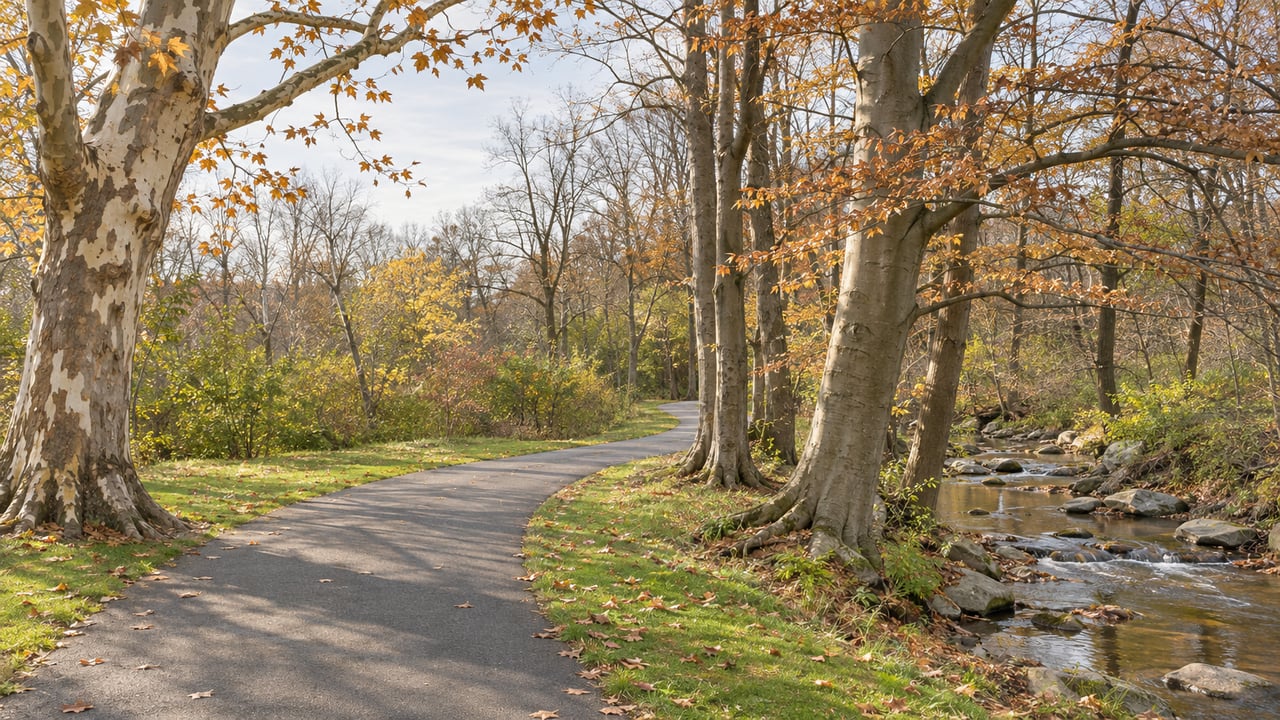
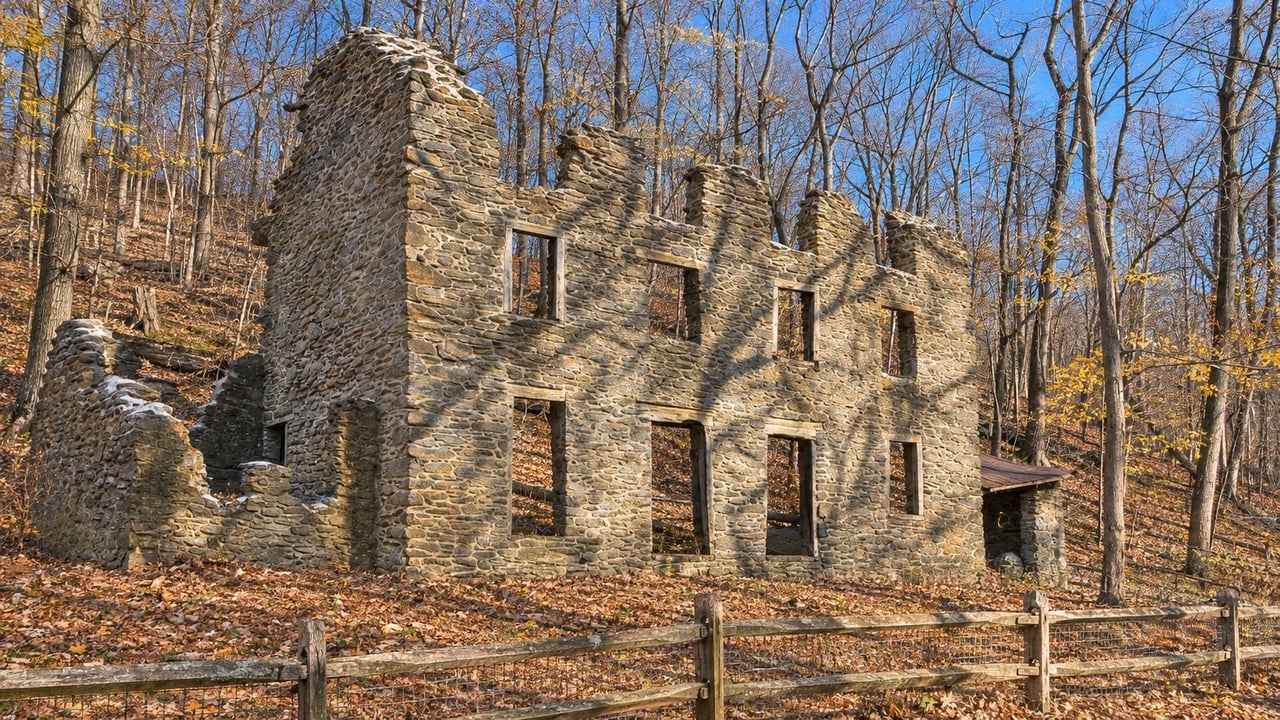
From the parking area at the top of Rolling Hill Park, the path down to Mill Creek drops through 103 acres of meadow and woods off Rose Glen Road in Gladwyne. On the way down are stone walls with no roofs and empty window openings. These were houses. Mill families lived in them while the creek below ran their machines. At the bottom of the hill, just past the park line, stands a large mill building with arched windows. It is the one mill in the valley that kept running after the others stopped.
That mill is Barker Mill at 1400 Mill Creek Road. On November 16, its owner went before Lower Merion's Historical Commission with a plan to renovate it. If you have family in town this weekend and want a walk that gets everyone out of the house, this one goes downhill through the ruins of the mills that were lost and ends at the mill that survived.
Twenty-Two Mills on One Creek
The ruins make more sense once you know how crowded this creek was. According to a 2014 Main Line Media News piece on the mills of Mill Creek, drawn from the Lower Merion Conservancy's own history of the valley, twenty-two mills ran along Mill Creek between 1684 and 1956. They stretched from the Harriton Farm in Bryn Mawr down to the Schuylkill River and made paper, flour, sheet metal and yarn. Water power on the creek ended with a severe flood in 1893.
The land inside Rolling Hill Park was always meant for milling. The Lower Merion Historical Society traces it to three tracts that Welsh settlers bought from William Penn's grants, with two of them crossing Mill Creek where the water ran clear and fast. Lower Merion Township bought the property, then the Walter C. Pew Estate, in 1995. It was the last and largest park the township acquired in the 20th century.
The Biggest Ruin Belonged to a Paper Mill
The western end of the park was Frederick Bicking's land. Bicking was a German papermaker who bought a mill site here in 1762 and grew his holdings to 255 acres, reaching the Schuylkill by 1798. The historical society's account of Lower Merion's papermakers says that during the Revolution, Bicking co-signed a petition warning that drafting every man from 16 to 50 would shut down every paper mill on the continent, leaving no paper for printers or ammunition. The petition succeeded. Papermakers were exempted, and some were even called home from military service. Bicking died in 1809, and his family cemetery is still in a backyard on Fairview Road.
In 1840 the site was bought by Henry Deringer, a pistol manufacturer from Northern Liberties. By then the deed listed a "tenement" for workers' families. The historical society identifies that tenement as the largest roofless structure standing in the park today, set back from the creek. There is little evidence that Deringer made many weapons here. In 1849 he sold the site to his son-in-law, William H. Todd, who turned the paper mill into a cotton yarn factory. So many people came to work there that the settlement was called Toddstown. In 1878 Todd sold the mill at a sheriff's sale, and Gilbert Fox ran it as the Glencairn Mill.
The old paper mill had one more job before it went quiet. The Lower Merion Conservancy's history hikes end the milling story at this tenement ruin. A 2013 Main Line Media News column describes how the Bicking mill was last used to generate electricity for the Percival Roberts estate up the hill.
The Double House Above the Rifle Works
Another ruin stands on the old Nippes property at the eastern end. The historical society describes it as a three-story double house for mill workers, likely built around 1825. The Conservancy's hikes stop at this worker housing so that fourth graders can picture living in these small multi-family homes. The 2013 column says the children also learn to spot non-native garden plants left behind by the tenants. Those plantings are worth watching for once the leaves are down. In late November, a shrub or groundcover that doesn't match the woods around it often marks a spot where a family once kept a yard.
The Nippes family's rifle works lay downhill from the double house, at the creek. The historical society dates the industrial use of that end of the park to 1794, when Benjamin Brooke set up a forge or gunpowder works. The site later became a rifle factory under the Nippes family and then a wool carpet yarn mill.
The Mill That Got Through 1893
Barker Mill is the reason this walk has an ending. A 2014 Main Line Media News report says J. Abraham Nippes, a gunsmith from Northern Liberties, bought the land in 1807 to set up a gun factory. The factory was in place to sell weapons to the young federal government during the War of 1812. After the Civil War, William Booth and his half-brother Thomas Barker turned it into a carpet yarn mill. The Barker family bought it in 1924 and kept it running until 1956.
It outlasted the others because of good timing. The 2013 column says the mill had switched to steam power the year before the 1893 flood, which ended milling everywhere else on Mill Creek. It went on to produce ten tons of carpet yarn a week. After the yarn stopped, the building held other businesses. Main Line Media News reported in 2015 that one of them was a recording studio used by Boyz II Men, until 2003. The mill is a Class I historic resource in Lower Merion and part of the Mill Creek Historic District, which is on the National Register of Historic Places.
Twenty Years of Plans for the Same Two Buildings
Plans to turn the mill into homes are older than many of the kids who will walk past it this weekend. In 2003 developer Brian O'Neill bought the two-acre parcel just below the park. A township memo dated May 10, 2019 records how the plan grew. A 2004 sketch converted the two mill buildings and added a new one for 22 condominium units. That became 27 units in 2005, and an amendment in September 2006 brought the total to 33 condominium units. The new building was planned for the slope next to Rolling Hill Park.
Construction never started. The 2014 report says the condominium market stalled along with the economy. In late 2012 the property went to auction, and a buyer who wanted to make it a yoga retreat could not close the deal. In November 2015, the Goldenberg Group, a prospective buyer, presented a more modern design to the Historical Commission. In 2018 MONTCO.Today reported that a new developer was poised to buy the site. The township took up the 33-unit project again in 2019, with a board decision in February 2020.
This month the plan moved forward again. The November 16 Historical Commission agenda says the owner and developer of the former Barker Mill "is proceeding with the 2006 approval of the site's redevelopment, which includes the retention and renovation of the historic mill buildings." The commission was asked to comment on the renovation plan, including exterior finishes and new balconies and windows. The application materials and the consultant's preliminary comments are linked from that agenda page. The same agenda also had the barn rehabilitation at Riverbend at 1950 Spring Mill Road. Two historic Gladwyne buildings that were built for work came before the same commission on the same afternoon.
The Park Is Getting a Plan Too
Lower Merion is drawing up a master plan for Rolling Hill Park. A steering committee of residents, a public survey and public presentations are part of the process, and the township's Rolling Hill Park master plan page still links to the survey. The draft will be posted on that page once it is written. If you walk here this weekend, you'll have something to say in the survey.
The creek is part of the township's plans as well. In September 2024, Main Line Media News reported that commissioners approved a $2.648 million contract with Flyway Excavating. It covers stream restoration on Mill Creek along the park, tributary restoration at Rolling Hill Dam near Rose Glen Road, and stabilization of Mill Creek Road. A state permit application for the tributary portion, received May 18, 2026, describes the work as running along Rose Glen Road between the pump station and the existing dam. It includes bank stabilization and four rock riffles to control the stream's grade.
Before You Load the Car
The park is open from sunrise to sunset, which this weekend means getting back up the hill before an early dusk. Rolling Hill also has a fenced dog area, and the township's Parks and Recreation office posts the details on its off-leash dog program page. The trails are shared with horses. The Lower Merion Conservancy has a GPS trail map, and it notes that the map is a general guide and does not show every path.
If your guests want more mill history after the park, keep going along Mill Creek Road and Old Gulph Road. The 2014 Conservancy-sourced history points out the remnant wall and historic marker of John Roberts III's 1746 grist mill on Old Gulph Road, just before Mill Creek Road. It also notes the ten-mile stone near the ford, which marks the distance to Philadelphia. The Gladwyne Library has four seasonal paintings of the Dove mill ruins, made in 1872. For more on how Gladwyne's village center is changing, read our look at the village plan, or browse the Gladwyne neighborhood page.
Many Gladwyne homes along Mill Creek have stories like these, some told in old deeds and some in the stone walls in the woods behind them. If you own one of the valley's older properties and want to understand how its history fits into today's market, the Houder Nuñez-Strid Team would be glad to walk through it with you. Schedule a Confidential Market Consultation.